The gods’ dwelling
Olympus
A divine home beyond bad weather. A household still full of disagreement.
Ancient Greek epic
Olympos
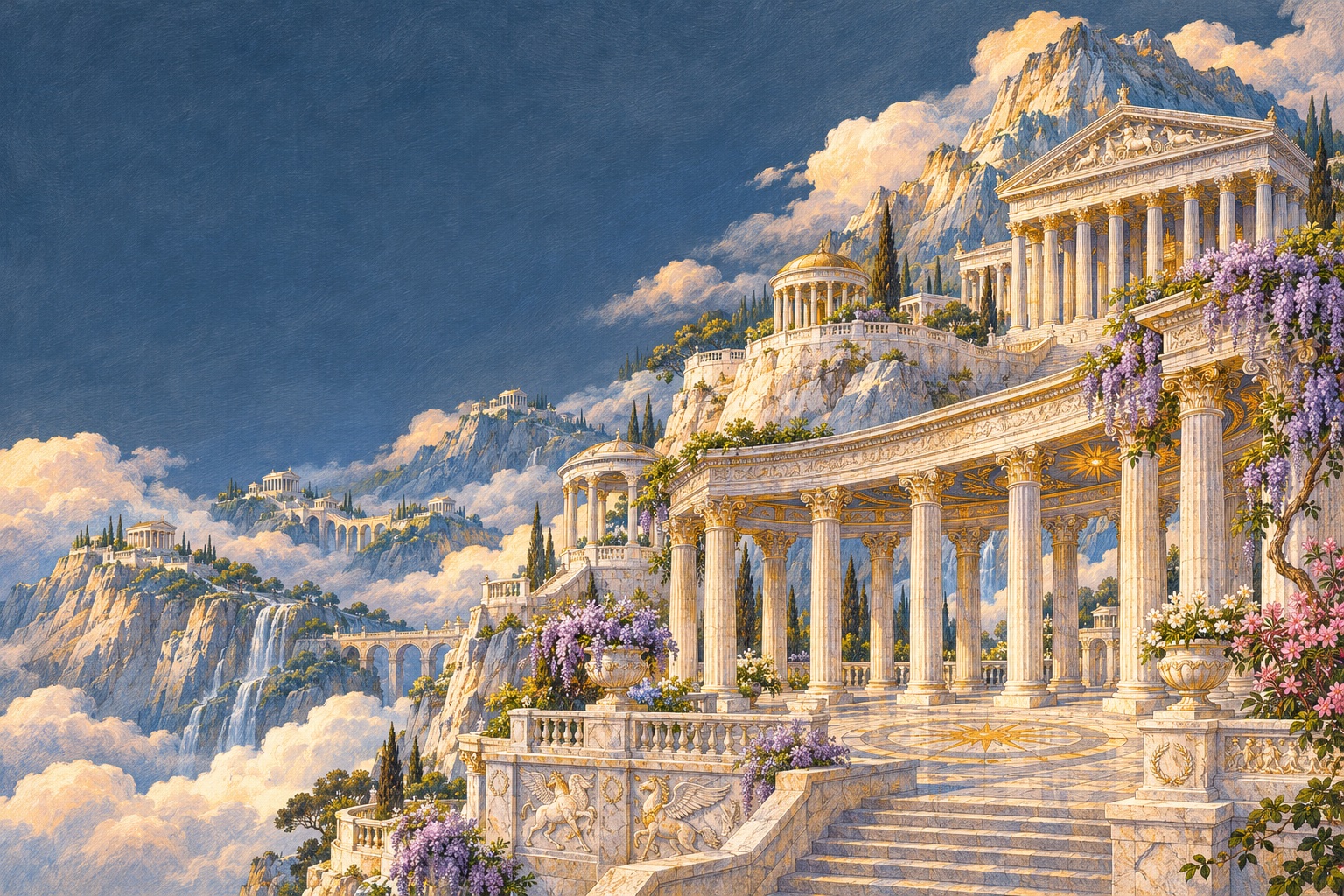
A place beyond the weather
Athena has been to Nausicaa in a dream. When she leaves, the Odyssey briefly opens a view of the place to which she returns. Olympus is described as secure and clear; rain, snow and wind do not trouble it. The passage is small, but its contrast is large. The weather that shapes mortal life does not reach this divine home. Read the description where the poem places it, at the end of a visit to a sleeping human being, rather than as a detached architectural specification.
The evening after an argument
The end of the Iliad’s first book offers a different kind of arrival. After a dispute among the gods, a feast continues until sunset. Apollo’s music and the singing of the Muses fill the evening. Then the gods go to their separate dwellings, which the poem attributes to Hephaestus. This Olympus is more than a distant summit: it has a shared social life and individual homes. An orderly evening need not mean that everyone agrees. The scene asks a reader to hold divine ease and divine friction together.
Keep both pictures in view
Put these two passages alongside each other and a productive tension appears. One emphasizes a home protected from the elements. The other follows its inhabitants through the end of a communal meal. Neither gives us a street-by-street city plan. Our illustration borrows the height, clear light and idea of separate dwellings, then invents its architecture. The useful next step is not to memorize that drawing, but to return to the two scenes and notice what each poet’s moment needs Olympus to be.
DETAILS TO NOTICE
A closer look.
Clear air
The Odyssey’s brief view of a weatherless dwelling makes a strong contrast with the exposed lives of mortals.
Music after the feast
Apollo and the Muses belong to the Iliad’s evening scene; the separate houses appear as the gods retire.
GO BACK TO THE TEXT
Sources & context.
The entry is an original introductory reading, not an exhaustive account of a culture or faith. Translations and editions mediate access; follow the exact passages and their surrounding context. Reviewed November 19, 2026.
Homer · Odyssey
Book 6, lines 41–46, within lines 1–47.
Dickinson College Commentaries
Greek text, vocabulary and scholarly commentary. The passage describes Athena’s return. Read the surrounding dream visit as well as the description of Olympus.
Open the sourceHomer · Iliad
Book 1, closing feast and retirement, especially lines 601–611.
MIT Internet Classics Archive · Samuel Butler translation
The older translation uses names such as Jove and Vulcan. This atlas uses Zeus and Hephaestus in its original summaries; the linked translation’s naming is different.
Open the source