The Æsir’s settlement
Asgard
Halls, a council court, a workshop—and a bridge that will not last forever.
Medieval Icelandic account of Norse traditions
Ásgarðr
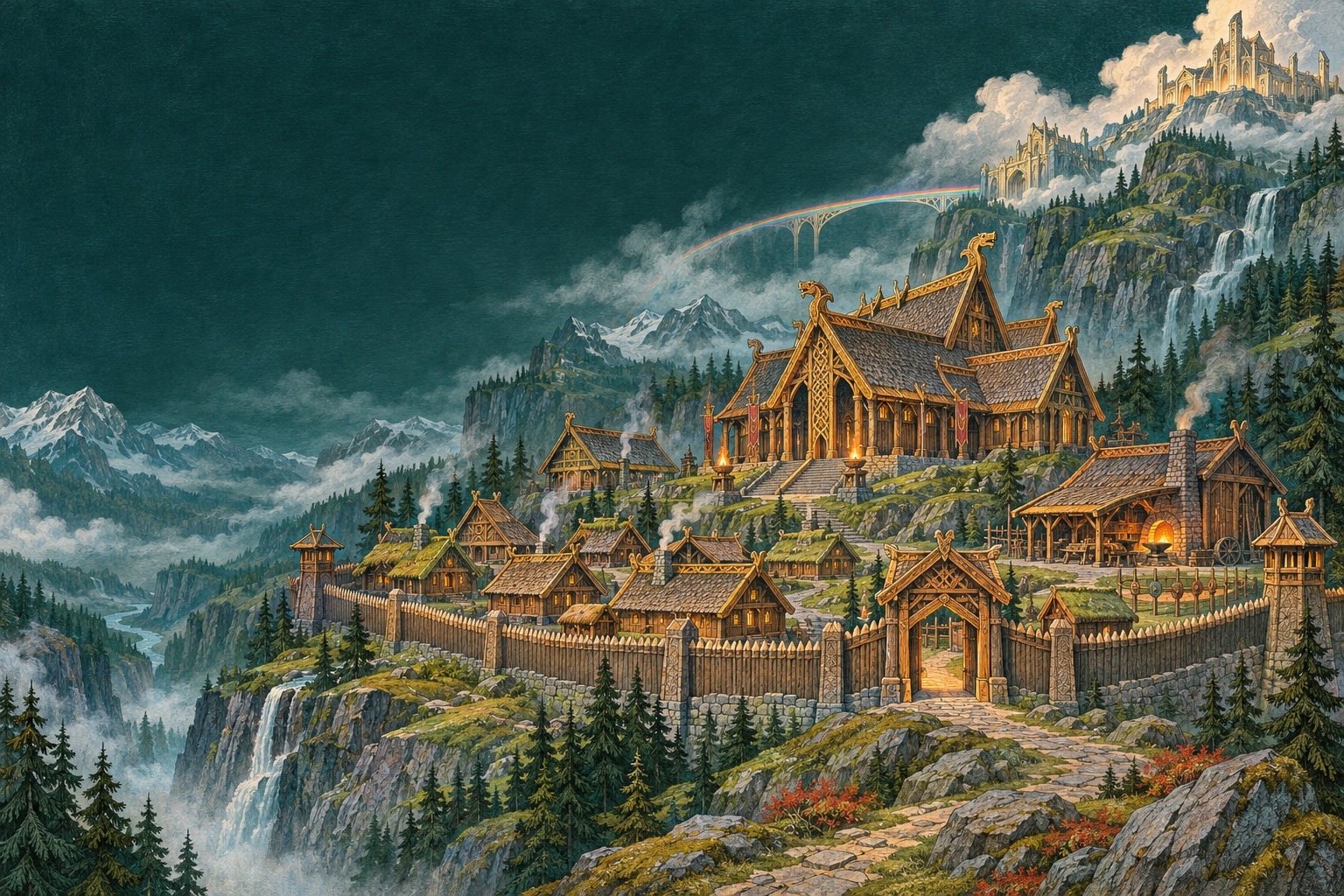
A place where things are made
In Gylfaginning’s dialogue, the gods establish a central council court at Iðavöllr. The account names Gladsheim and the goddesses’ hall Vingólf, and describes a workshop with a forge. These are useful details to linger over. Asgard is not only a shining destination seen from afar. In this telling it is also a settlement of decisions, gathering places and making. The narrative’s institutions matter as much as its setting.
The rainbow is a connection
The text identifies Bifröst with the rainbow and describes it as a bridge between earth and heaven. A bridge makes two places related without making them the same place. Yet this one is not an unlimited promise of security: the account also says it will break. For a reader, the bright connection and its vulnerability belong in the same picture. A diagram that turns every realm into a neatly arranged, permanent planet would lose that tension.
The question of an enclosure
Later, a builder offers to construct a defensive enclosure. The arrangement leads into the story involving Loki and the horse Svaðilfari. The passage is another reminder that this settlement has a history of bargains and contested boundaries. Read it as an episode in Snorri’s work, not as the building record of an archaeological site. Valhalla, a named hall in Norse material, should likewise not be used as another name for all of Asgard, or as an afterlife promised to everybody.
DETAILS TO NOTICE
A closer look.
The council court
Iðavöllr gives the settlement a center of collective decision in chapter XIV.
The vulnerable bridge
Bifröst’s rainbow joins earth and heaven in chapter XIII, which also describes its future breaking.
GO BACK TO THE TEXT
Sources & context.
The entry is an original introductory reading, not an exhaustive account of a culture or faith. Translations and editions mediate access; follow the exact passages and their surrounding context. Reviewed November 19, 2026.
Snorri Sturluson · Gylfaginning
Chapters XIII–XV for Bifröst, the council court and halls; chapter XLII for the builder.
Wikisource · Arthur Gilchrist Brodeur translation (1916)
A dialogue in the Prose Edda, compiled in Christian medieval Iceland. This is a mediated literary witness, not a single unchanging account shared by every earlier Norse community. An archive edition is also linked; that publisher can restrict access or respond slowly.
Open the source Alternate edition or publisher page