A landscape of the night journey
Duat
The sun travels through darkness. The journey ends in renewal.
Ancient Egyptian funerary cosmography
Also rendered Tuat in older translations
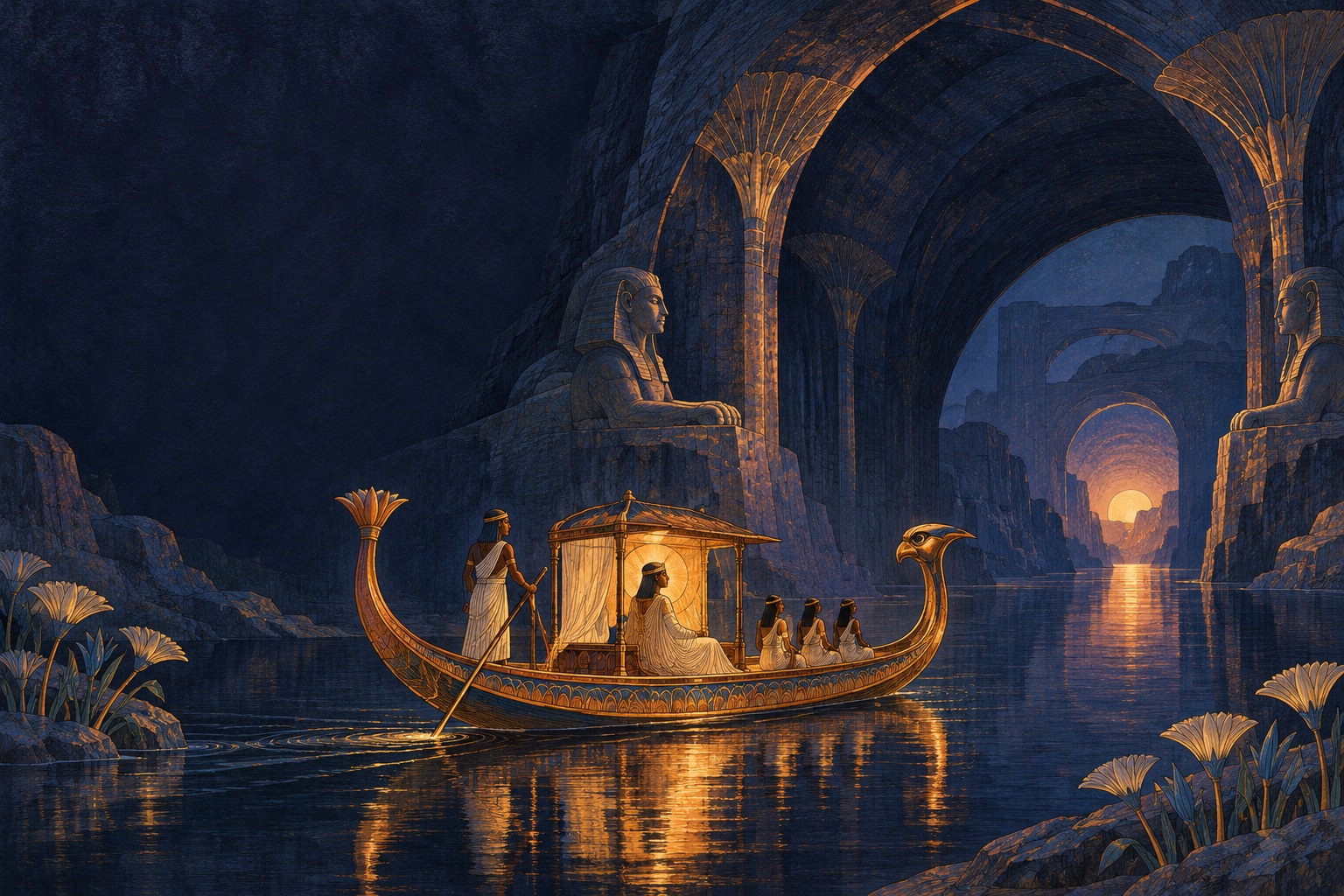
Time becomes a landscape
The Amduat follows the sun god through twelve nocturnal divisions. Its order is the order of a journey through the night. To approach it only as a catalogue of frightening inhabitants is to miss that movement. In this composition, what matters is not simply being somewhere below the daylight world. The traveler passes through a sequence. Our illustration therefore centers a boat beneath a dark arch; it is an editorial image of passage, not a diagram of all twelve divisions.
Begin with the boat
The first division includes a river and the sun god’s boat. Start there, with a form of travel, before trying to read every figure on the page. An old illustrated edition can help a reader see how text and image occupy the same account, but its spellings and explanations also belong to its own period. The linked 1905 edition is useful primary-text access, not a substitute for current specialist interpretation. Detailed deity lists or exact geometry need more careful study than this short introduction can provide.
The far end is a beginning
The final division describes the renewed emergence of the sun god in the form of Khepri. The sequence is therefore not exhausted by an idea of punishment: the chosen text follows a cycle that returns toward light. This is why the atlas places “The long way through” beside this entry. That reading path is our editorial comparison, not an assertion that Egyptian and Kʼicheʼ accounts tell the same story. Keep the Amduat’s own sequence intact when moving between traditions.
DETAILS TO NOTICE
A closer look.
The river and boat
The opening division gives a concrete starting image for the nocturnal passage.
Renewed emergence
Chapter XII turns the night journey toward the sun god’s renewed form, Khepri.
GO BACK TO THE TEXT
Sources & context.
The entry is an original introductory reading, not an exhaustive account of a culture or faith. Translations and editions mediate access; follow the exact passages and their surrounding context. Reviewed November 19, 2026.
The Book of Am-Tuat
Chapters I–XII; first division pp. 3–4; final division pp. 256–259.
Wikimedia Commons facsimile · E. A. Wallis Budge edition (1905)
The historical title “Heaven and Hell” and older spellings reflect the editor’s period. They do not make the Duat an equivalent of Christian Hell. Chapter availability can be intermittent; the facsimile is an alternate way to locate the cited printed pages.
Open the source Alternate edition or publisher pageThe First Division
Chapter I, opening, printed pp. 3–4.
Wikisource · transcription of the Budge edition
A second route into the opening river-and-boat scene. This is the same older edition, not an independent ancient account.
Open the source