Poetic land, historical place
Dilmun
An untouched land still needs fresh water. Paradise has an infrastructure question.
Sumerian literature and a historical Gulf region
What the poem removes
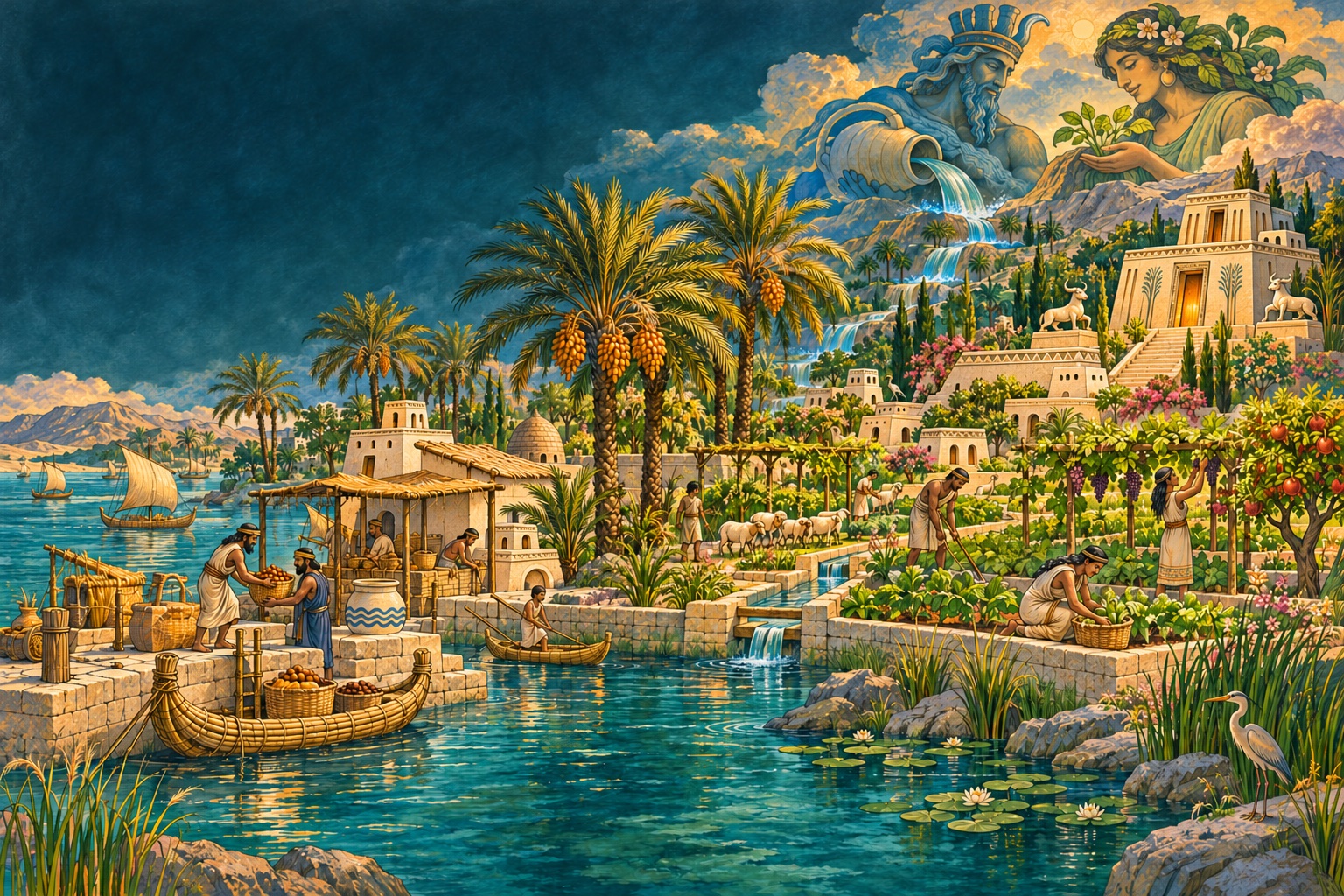
The opening of Enki and Ninḫursaĝa presents Dilmun through striking absences: predation, illness and aging do not trouble its pristine scene. Rather than supplying a modern map, the passage changes the conditions under which a land is imagined. It is worth reading those absences slowly. What kind of place appears when familiar dangers and signs of decline fall away? That question is a way into this particular poem, not proof that an excavated landscape once had those properties.
A question interrupts the picture
Ninsikila challenges Enki about a city without productive fields and a river quay. The ideal scene has a practical lack. Enki promises fresh water; the following passage connects Utu’s rising with water, grain and the activity of an emporium. This turn is what makes the entry especially rewarding to read beside Olympus. The comparison is editorial: one selected text imagines protection from weather, while another turns toward the water that lets a place function.
A real name, more than one register
Dilmun also belongs to history. UNESCO identifies Qal’at al-Bahrain as the ancient harbour and capital of Dilmun. That is a different kind of claim from the poem’s depiction of an untroubled land. We place the two sources beside each other to keep them distinguishable. The Oxford literary edition also marks manuscript variants, gaps and additions. Those signs are part of reading the evidence; smoothing them into a confident map would give the account a certainty the edition itself does not claim.
DETAILS TO NOTICE
A closer look.
Fresh water
Enki’s promise changes the conditions of the city in the poem’s lines 40–62.
The working quay
The complaint about productive land and a river quay makes room for a practical question inside the ideal scene.
GO BACK TO THE TEXT
Sources & context.
The entry is an original introductory reading, not an exhaustive account of a culture or faith. Translations and editions mediate access; follow the exact passages and their surrounding context. Reviewed November 19, 2026.
Enki and Ninḫursaĝa
ETCSL 1.1.1, lines 1–62: pristine land 1–28; complaint 29–39; water and transformation 40–62.
University of Oxford · Electronic Text Corpus of Sumerian Literature
A composite scholarly edition. Brackets, gaps, variants and the separately marked manuscript addition are meaningful. This atlas summarizes the opening episode; it does not reproduce the translation.
Open the sourceQal’at al-Bahrain
World Heritage property 1192, description and historical context; ICOMOS evaluation available as an alternate.
UNESCO World Heritage Centre / ICOMOS
Historical and archaeological context. This establishes a different register of evidence from a description of the poem’s pristine land.
Open the source Alternate edition or publisher page