The High Plain of Heaven
Takamagahara
A heavenly beginning whose light and authority reach into the land below.
Japanese · Kojiki; living Shinto traditions
Also Takaamanohara
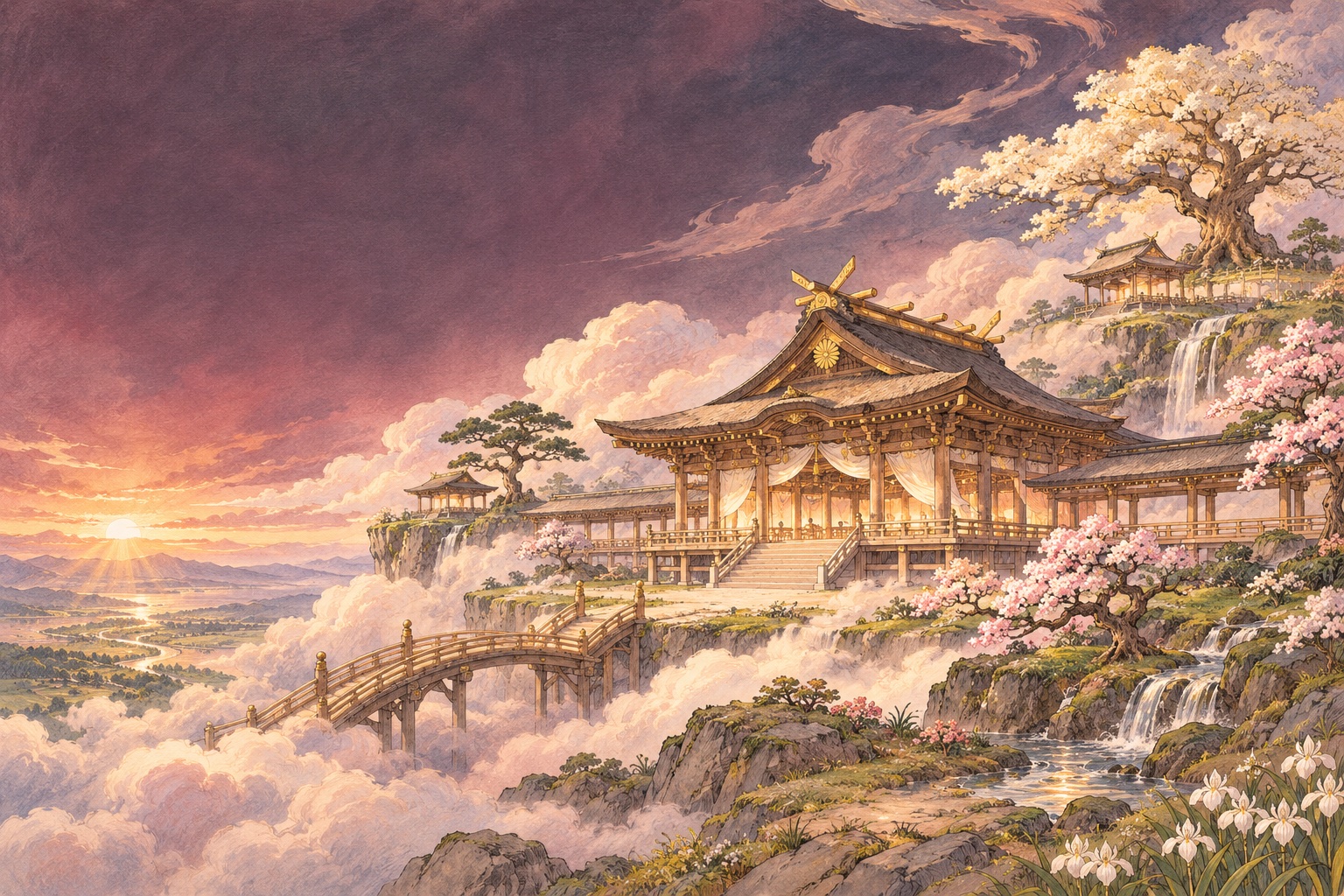
A beginning in the heavenly plain
The Kojiki opens with deities coming into being in the High Plain of Heaven. Later, Izanagi assigns Amaterasu rule over that realm. These passages make the plain a setting for beginnings and for an allocation of authority. They do not hand a reader a physical survey. Common romanizations of the name vary; the Kokugakuin University resource is a useful place to see the Japanese text, translations and scholarly annotations together.
When the light withdraws
In the heavenly rock-cave episode, Amaterasu withdraws. Both the heavenly plain and the Central Land of Reed Plains become dark. That relationship is the focus of our reading: an event in the heavenly setting has consequences beyond it. The atlas’s sky and distant light are artistic responses to that passage. They should not be mistaken for an ancient depiction or for a claim about the physical location of the realm.
The account turns toward the land
Ninigi’s descent connects the heavenly narrative with rule in the terrestrial land. Read the descent after the opening and the cave episode to notice different kinds of connection: coming into being, the reach of light, and the movement of authority. These are themes in the passages selected here, not a complete account of Shinto traditions. The atlas describes a literary and sacred source without asking the reader to adopt a theological judgment about it.
DETAILS TO NOTICE
A closer look.
Light across realms
The cave episode describes darkness in both the heavenly plain and the Central Land of Reed Plains.
The descent
The account of Ninigi carries the heavenly narrative toward the terrestrial land.
GO BACK TO THE TEXT
Sources & context.
The entry is an original introductory reading, not an exhaustive account of a culture or faith. Translations and editions mediate access; follow the exact passages and their surrounding context. Reviewed November 19, 2026.
Kojiki · Beginning of Heaven and Earth
Opening of the upper volume; corresponds to Chamberlain §I.
Kokugakuin University · Studies on the Kojiki
Primary Japanese text with translations and specialist annotations. Reading and romanization conventions vary.
Open the sourceKojiki · The Three Noble Children
Upper volume, division among the three noble children; Chamberlain §XI.
Kokugakuin University
The assignment of Amaterasu’s rule belongs to this episode.
Open the sourceKojiki · Heavenly Rock-Cave I
Upper volume, cave episode, final sentences; Chamberlain §§XV–XVI.
Kokugakuin University
Read the heavenly and terrestrial consequences in the same passage.
Open the sourceKojiki · Descent of the Heavenly Grandson I
Upper volume, descent episode; Chamberlain §§XXXII–XXXIV.
Kokugakuin University
One route into the Japanese text and its scholarly annotations.
Open the sourceKojiki · Ninigi’s arrival
Basil Hall Chamberlain translation (1882), §XXXIV.
Wikisource
A public-domain older translation offered alongside the university resource. Its historical language and choices require context.
Open the source